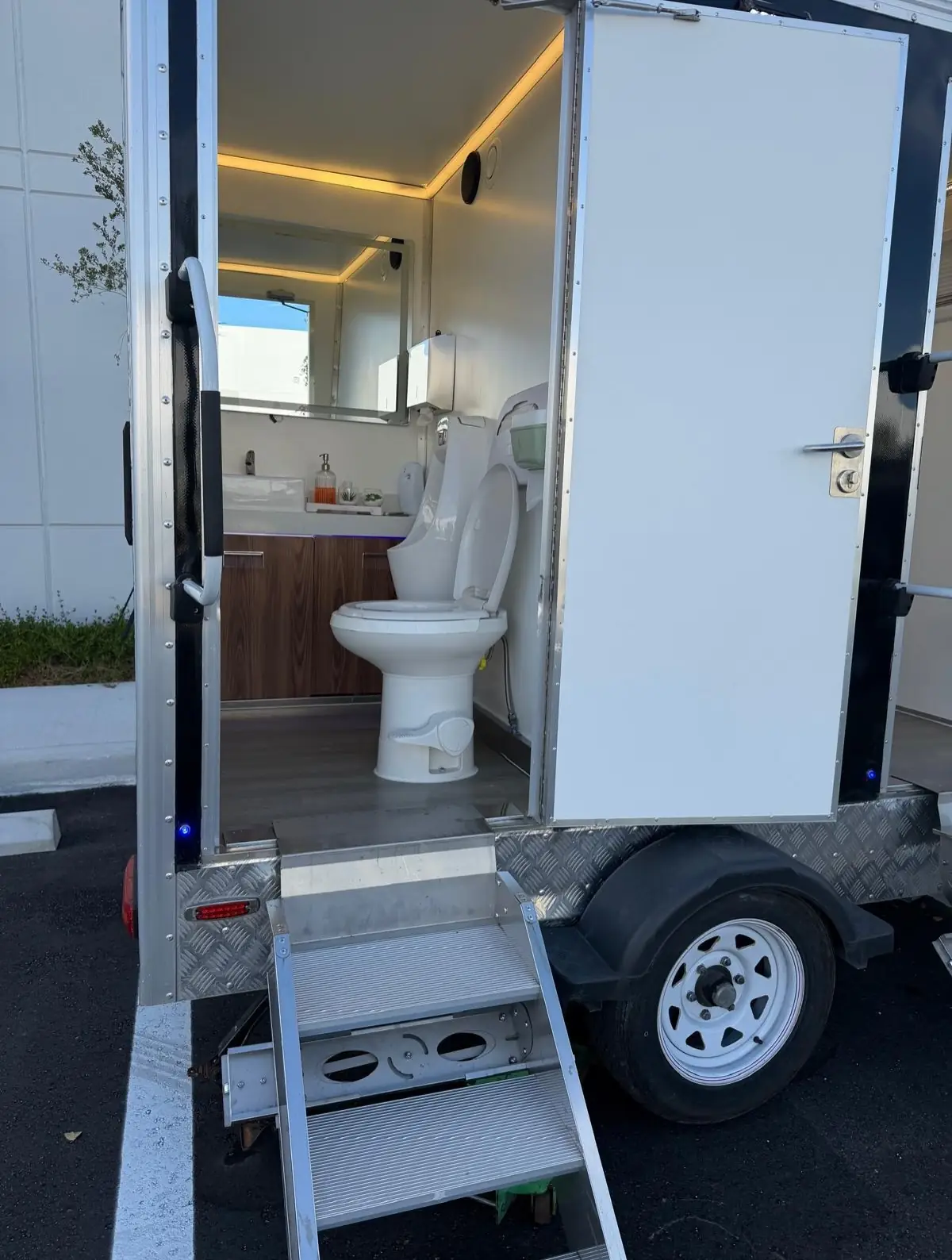
Which is better for a wedding: a trailer or porta potties?
A restroom trailer is better when the venue has a 110-volt outlet, a level spot and a truck-wide road, and you want running water, lights and mirrors. Flushing porta potties with sinks are better for remote, steep or off-grid sites, and they cost less for the same guest count.
| Restroom trailer (2-station) | Flushing units with sinks | |
|---|---|---|
| Guests served (5 hrs) | About 100 per trailer | About 35–50 per unit |
| Typical cost | $1,200–$1,800 per event | $275–$395 per unit |
| Power | 110 V outlet or generator | None |
| Water | Onboard tank. Hose optional | Onboard tanks |
| Access | 10 ft road, turnaround, level pad | Path 52 in wide |
| Wheelchair access | Steps. Add a ground-level unit | Add an accessible unit |
| Guest feel | Indoor bathroom | Clean, upgraded portable |
How many of each does 150 guests need?
A 150-guest, 5-hour wedding with a bar needs 5 units under our planning method. That can be 4 flushing units plus 1 accessible unit, or one 2-station trailer plus 2 flushing units plus 1 accessible unit. Both plans keep lines short through the last dance.
What do Sonoma venues usually allow?
Many Sonoma and Napa wineries have a set spot for restroom trailers near the barn outlet. Private ranches and backyards often have no truck-wide path, which points to flushing units. Ask your venue coordinator for a photo of the restroom spot and send it to us.
Details: restroom trailer specs, flushing unit specs, wedding planning page.